Wanting to support marginalized scientists, particularly disabled scientists of color, in 2024, TERC researchers Lisette Torres-Gerald and Christina Silva conducted a pilot study to develop and refine a new data collection methodology called Contemplative CRiT Collage (CCC). Its intention is to aid in the mending of scientists of color with disabilities who encounter negative experiences in STEM. It is a new approach to supporting their persistence in STEM. The CCC pilot was a two-year study to evaluate the methodology’s impact on the participants' experience.
STEM education and careers are known for being inhospitable to people of color and those with disabilities (e.g., McGee, 2020a, b; Shinohara et al., 2021). Examples of this inhospitality include racial microaggressions (Lee et al., 2020), sexual harassment (Clancy et al. 2014), credit and recognition gaps (Rossiter, 1993; Hofstra et al. 2020), cultural taxation (Padilla, 1994), inaccessibility and insufficient accommodations (Shinohara et al., 2021), and stigmatism (Sarju, 2021). This hostile environment forces scientists with marginalized identities to develop survival strategies that are unsustainable and ultimately physically, psychologically, and emotionally harmful. Signs of trauma, which include dissociation, minimization, and numbing (Haines, 2019), along with racial battle fatigue (Smith et al., 2006; Smith et al., 2011) can develop.
CCC offers a way to not only “connect critical race theory (CRT) as a theoretical construct to a livable, observable, teachable process of critical consciousness, knowing and doing” (CRiT walking - Hughes & Giles, 2010, p. 42), but to propose the development of a method to move toward community- and self-mending within STEM for disabled scientists of color and to study their experiences in STEM. Like Ortiz (2018), mending is used rather than healing because mending recognizes that although the wound is closed, or the direct effect has long since vanished, the body and mind are no longer the same. They have been forever changed by the hurt they have experienced. Thus, the aim of CCC is to mend the hurt within scientists of color to try to minimize traumatic retention and address institutionalized trauma (Menakem, 2017). CCC also adds meditation training, which has been demonstrated to reduce stress and improve telomere regulation associated with aging (Conklin, Crosswell, Saron, & Epel, 2019).
Origins of a New Methodology
Torres-Gerald first began developing the unique methodology of CCC as a doctoral student looking for a way to document the stories of women of color in STEM while addressing the pain that she knew many of them were in, especially given her own journey (Torres, 2016). This methodology was born during Torres-Gerald’s reflections on racial equity, social pain, and trauma in STEM over a decade earlier. She has intimate experience of racial battle fatigue and disability and learned about arts-informed methodologies and critical theoretical frameworks from her doctoral advisor, Dr. Nana Osei-Kofi. She is also a practicing certified mindfulness instructor and is furthering her knowledge by learning about somatics, a field that fosters the mind-body connection and addresses emotional and traumatic experiences.
What is CCC?
CCC is an arts-informed methodology that integrates collage, photo elicitation, contemplative practice, and CTR.
Arts-informed research (AIR) and collage. AIR is a qualitative approach that uses art as inspiration, as part of the research process and as communication with broader audiences (Cole, 2015). It can intervene aesthetically to reveal injustice and foster resistance (hooks, 1995), raise critical awareness (Leavy, 2009), and connect academia with community life in accessible and evocative ways (Cole, 2015). Collage is an artmaking practice that can serve as a culturally responsive AIR tool for embodied data collection and expression in STEM educational spaces.
Central to CCC, collage has long functioned as a subversive art form, challenging dominant narratives of authority and essentialism (Butler-Kisber, 2008; Davis, 2008). By assembling found images and objects, it reveals intersections of experience through intuition, affect, and disorientation (Davis, 2008; Davis & Butler-Kisber, 1999). Collage also supports reflexivity in qualitative work, helping to conceptualize questions, process data, and write (Butler-Kisber, 2008). Its defining qualities—juxtaposition, interdisciplinarity, everyday grounding, cultural critique, and openness—make it a strong complement to CRT in reimagining STEM (Vaughan, 2005).
Photo elicitation. Photo elicitation, rooted in visual sociology and anthropology (Collier, 1957; Harper, 2002), invites participants to co-create data through images that evoke memories, emotions, and deeper reflection than words alone (Harper, 2002; Leavy, 2009). Trauma-informed and accessible (Malchiodi, 2020), it fosters intimacy and rich narratives (Jaumot-Pascual et al., 2024). Within CCC, collage, influenced by photo elicitation, can help participants recall experiences, cross cultural boundaries, and express affective dimensions of STEM life.
Contemplative practice. Guided contemplation—nonjudgmental attention to the present moment—supports grounding, creativity, and emotional processing (hooks, 1995; Davis & Butler-Kisber, 1999). Even brief contemplative activities can enhance cognition, mood, and prosocial behaviors (Heppner & Shirk, 2018). Within CCC, contemplative art creates space to surface intuitions, tensions and power in the experiences of disabled people of color in STEM.
Engaging CCC
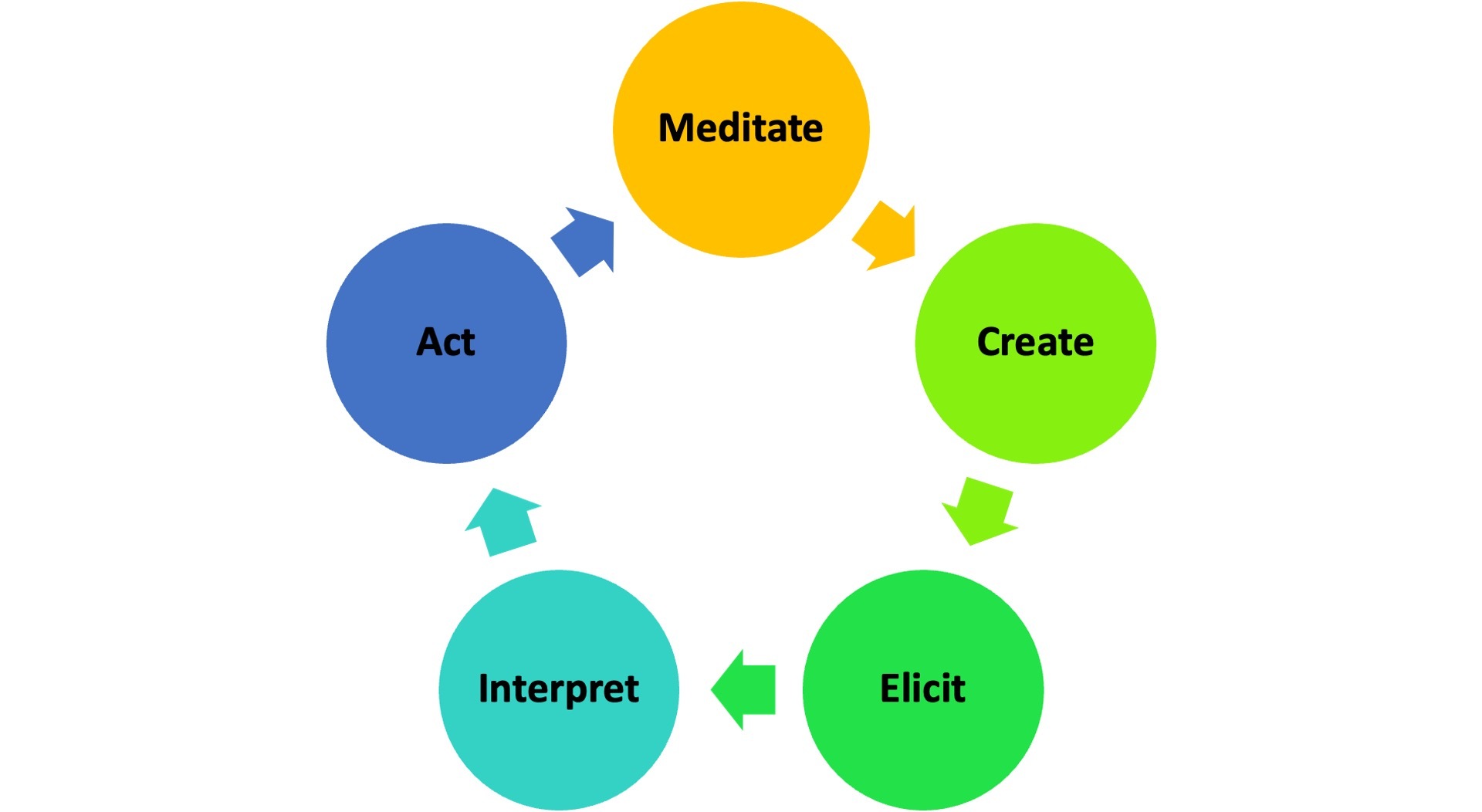
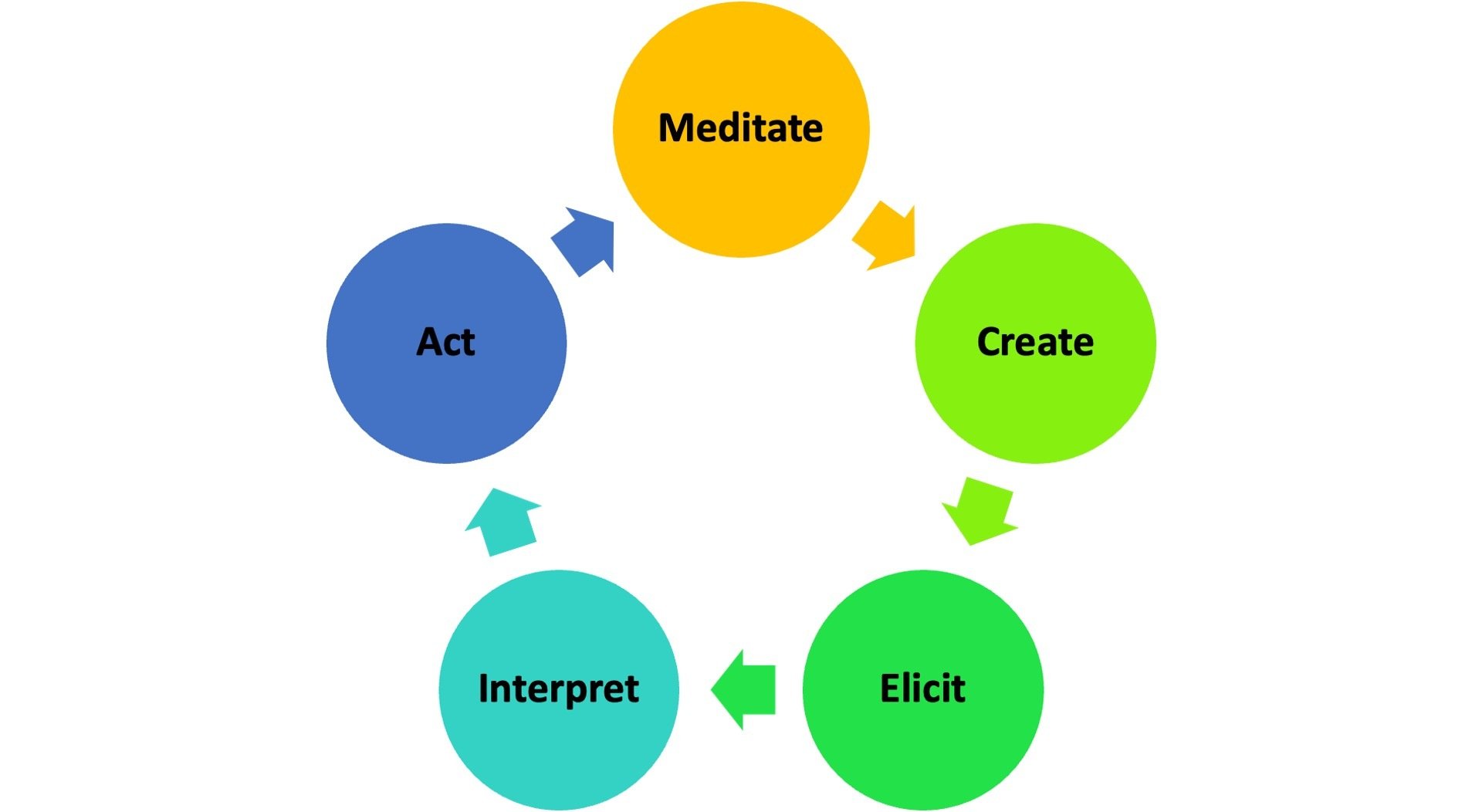
In general, CCC is a cyclical process that is participant-centered, starting with contemplation and moving through creation, elicitation, interpretation, and action (Figure 1). Specifically, participants engage in a 15- to 20-minute contemplative practice. Afterwards, the participants create their own collage work based on a series of prompts related to their lived experiences in STEM. Once the collage pieces are created, the researcher and the participant come together to dialogue about the works and their meaning during a 90-minute interview. The researcher uses the pieces to elicit responses from the participant as well as to interpret the meaning of the collages together. Based on the conversation, the researcher and the participant determine an action, whether that be the co-construction of a collage that deepens both their understandings of the participant’s experience; the development of a strategy, practice, or community action; or another contemplation session. The work “will be complete when [participants] have remembered enough” (Vaughan, 2005, p. 10).
Benefits By Participants
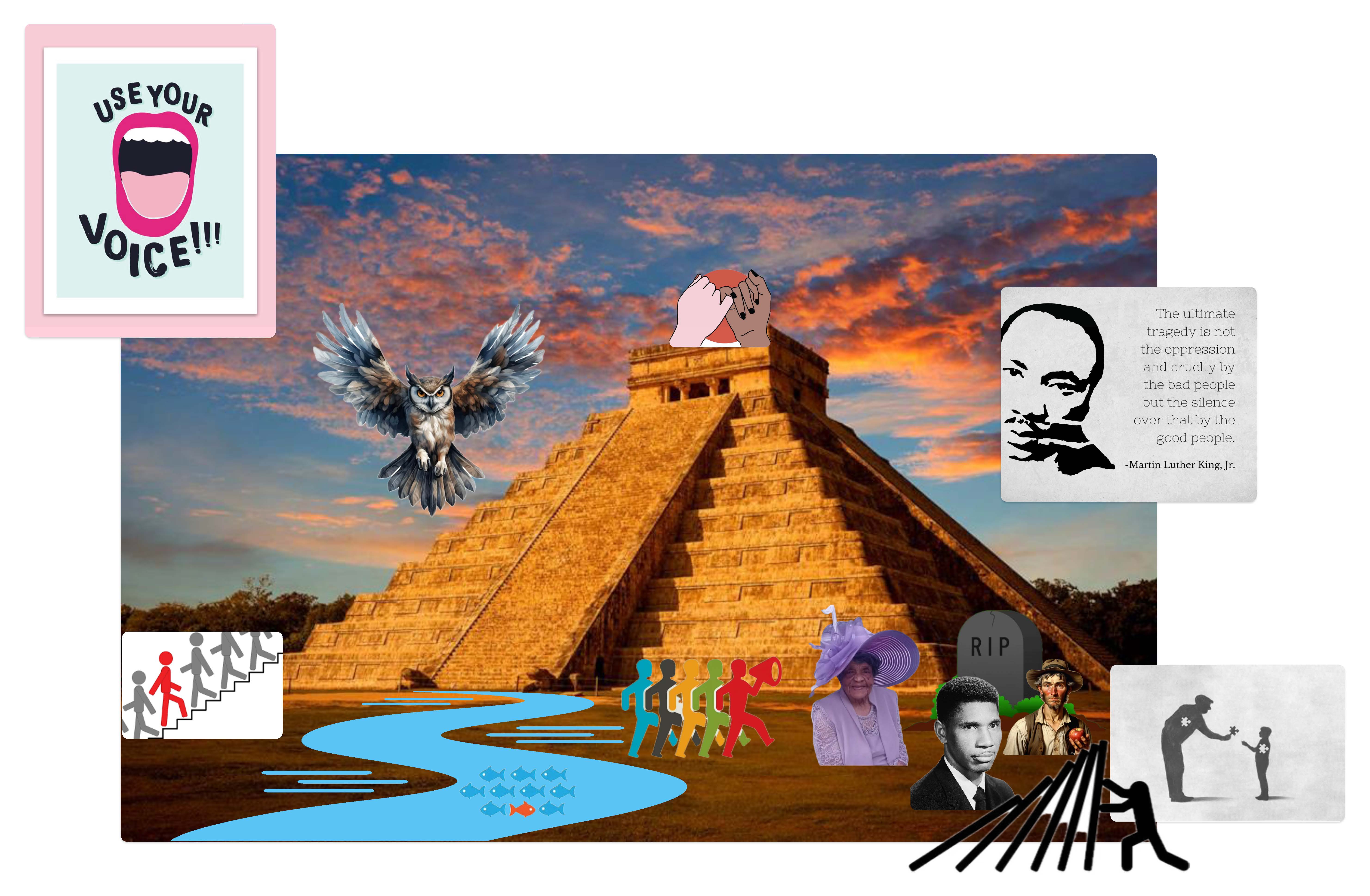
The CCC pilot study was conducted in 2024 and 2025 with four disabled women graduate students (three women of color, one self-identified “non-white” woman) in STEM (one in natural sciences, two in physical sciences, and one in engineering). The purpose of the study was to develop and refine CCC as well as to begin to assess its usefulness and impact on participants. When asked about their experience with CCC in a one-on-one interview, Mineral, a disabled non-binary Black doctoral candidate in the physical sciences, focused on the contemplative aspect (see Figure 2), stating,
It [the contemplative sessions] really changed my life. I don’t think I’ve ever really had— I think it was a combination of like, I don’t think I’ve ever really believed in meditation to that degree before, but also, I just was in a place in my life where I really needed it.
Etta, a disabled multiracial doctoral candidate in the physical sciences, similarly expressed,
It [the CCC process] was very therapeutic, yeah. I wish, you know, more of this, the meditation, the mental health aspects and things like that could be implemented into more of our graduate daily routines or at least promoted.
The pilot participants were appreciative of the methodology and its ability to encourage deeper reflection on their multiple identities. Tovah, a Hard-of-Hearing doctoral candidate shared,
[F]or someone like me, where I’m as comfortable as I am with my disabled identity, it’s like you still subconsciously bring things, or maybe things you thought you were over but you’re not really over and having that time to meditate on it helps with processing or helps with … thinking about what your role in certain spaces is.
Participants were so appreciative of the methodology that they all noted that they would like to continue with the project if expanded into a larger study.
Next Steps For CCC
The CCC pilot study ended in October 2025. Torres-Gerald and Silva have been focusing on the dissemination of findings and have already shared the CCC methodology at the Understanding Interventions that Broaden Participation in Science Conference, NCORE, and the New England Educational Research Organization Conference. They are currently writing a manuscript for submission to the academic journal Qualitative Inquiry and writing grant proposals to continue their work.
Acknowledgements
This material is based upon work supported by TERC through the CSTL General Fund project, Contemplative CRiT Collage. The opinions, findings, conclusions or recommendations expressed here are those of the authors and do not necessarily reflect the views of their institutions, employers, or funders.
We extend our deepest gratitude to all the participants who generously shared their time and experiences for this research.
Lisette Torres-Gerald is grateful for Dr. Maria Ong’s mentorship, encouragement, and support. She also would like to thank Rev. angel Kyodo williams and David Perrin for training her as a certified mindfulness instructor.
Author Bios
Dr. Lisette E. Torres-Gerald (she/her/ella) is a trained scientist and disabled scholar-activist who is a Senior Researcher at TERC and the Director of Inclusive Communication and Capacity Development for the national NSF-funded resource center called the Realizing Excellence and Vitality in Informal STEM Education (REVISE) Center. Dr. Torres-Gerald has a doctorate with a Certificate in Social Justice from the School of Education at Iowa State University, a M.S. in Zoology with a Certificate in Ecology from Miami University, and a B.A. in Earth and Environmental Science and Religion Studies (double-major) from Lehigh University. Her academic research focuses on addressing racialized gender justice and disability in science and higher education. She is an active member of Science for the People, a co-founder of Sines of Disability, and a co-founder and former executive board member of the National Coalition for Latinxs with Disabilities (CNLD). Dr. Torres-Gerald is also a member of the AAAS Multidisciplinary Working Group on Disability Inclusion and Anti-Ableism in STEMM.
Christina B. Silva (she/her) is a Researcher at TERC. She has researched and evaluated the experiences, persistence, and retention of members of underrepresented groups in STEM higher education and careers, particularly women of color and gender minorities. She is trained in qualitative meta-synthesis methods and arts-informed research (AIR) methods. Through AIR, she is committed to uplifting and sharing the stories of marginalized groups to broader communities outside of academia. She holds a Bachelor of Social Work from Simmons University.
References
Butler-Kisber, L. (2008). Collage as inquiry. In J.G. Knowles, A.L. Cole (Eds.), Handbook of the arts in qualitative research (pp. 265–276). Thousand Oaks, CA: Sage Publications.
Clancy, K.B.H, Nelson, R.G., Rutherford, J.N., Hinde, K. (2014). Survey of academic field experiences (SAFE): Trainees report harassment and assault. PLOS ONE, 9(7), e102172. https://doi.org/10.1371/journal.pone.0102172
Cole, A. L. (2015). Arts-informed Research: A transformative methodology. Baltic Journal of Psychology, 16(1, 2), 21–27.
Collier, Jr., J. (1957). Photography in anthropology: A report on two experiments. American Anthropologist, 59, 843–859. https://doi.org/10.1525/aa.1957.59.5.02a00100
Conklin, Q.A., Crosswell, A.D., Saron, C.D., & Epel, E.S. (2019). Meditation, stress processes, and telomere biology. Current Opinion in Psychology, 28, 92–101. https://doi.org/10.1016/j.copsyc.2018.11.009
Davis, D. (2008). Collage inquiry: Creative and particular applications. LEARNing Landscapes, 2(1), 245–265.
Davis, D., & Butler-Kisber, L. (1999). Arts-based representation in qualitative research: Collage as a contextualizing analytic strategy. Paper presented at the Annual Meeting of the American Educational Research Association, Montreal, Quebec, Canada.
Haines, S.K. (2019). The politics of trauma: Somatics, healing, and social justice. Berkeley, CA: North Atlantic Books.
Harper, D. (2002). Talking about pictures: A case for photo elicitation. Visual Studies, 17(1), 13– 26. doi:10.1080/14725860220137345
Heppner, W.L., & Shirk, S.D. (2018). Mindful moments: A review of brief, low‐intensity mindfulness meditation and induced mindful states. Social and Personality Psychology Compass, 12(12), e12424. https://doi.org/10.1111/spc3.12424
Hofstra, B., Kulkarni, V.V., Munoz-Najar Galvez, S., He, B., Jurafsky, D., & McFarland, D.A. (2020). The diversity–innovation paradox in science. Proceedings of the National Academy of Sciences of the United States of America, 117(17), 9284–9291, https://doi.org/10.1073/pnas.1915378117
hooks, b. (1995). Art on my mind: Visual politics. New York, NY: The New Press.
Hughes, R., & Giles, M. (2010). CRiT walking in higher education: Activating critical race theory in the academy. Race, Ethnicity and Education, 13(1), 41–57.
Jaumot-Pascual, N., Ong, M., Torres, L.E., Smith, T.D., Silva, C., & DeerInWater, K. (2024, April 12). Affordances and challenges of implementing photo elicitation with Native participants (Conference presentation). American Educational Research Association (AERA) Conference, Philadelphia, PA.
Leavy, P. (2009). Method meets art: Arts-based research practice. New York, NY: The Guilford Press.
Lee, M.J., Collins, J.D., Harwood, S.A., Mendenhall, R., & Browne, M. (2020). “If you aren’t White, Asian, or Indian, you aren’t an engineer”: Racial microaggressions in STEM education. International Journal of STEM Education, 7(48), 1–16. https://doi.org/10.1186/s40594-020-00241-4
Malchiodi, C.A. (2020). Trauma and expressive arts therapy: Brain, body, and imagination in the healing process. New York, NY: The Guilford Press.
McGee, E.O. (2020a). Interrogating structural racism in STEM higher education. Educational Researcher, 49(9), 633–644. doi:10.3102/0013189X20972718
McGee, E.O. (2020b). Black, Brown, bruised: How racialized STEM education stifles innovation. Cambridge, MA: Harvard Education Press.
Menakem, R. (2017). My grandmother’s hands: Racialized trauma and the pathway to mending our hearts and bodies. Las Vegas, NV: Central Recovery Press.
Ortiz, N. (2018). Sustaining spirit: Self-care for social justice. Berkeley, CA: Reclamation Press.
Padilla, A.M. (1994). Ethnic minority scholars, research, and mentoring: Current and future issues. Educational Researcher, 23(4), 24–27. https://doi.org/10.3102/0013189X023004024
Rossiter, M.W. (1993). The Matthew Matilda Effect in Science. Social Studies of Science, 23(2), 325–341. http://www.jstor.org/stable/285482
Sarju, J.P. (2021). Nothing about us without us – Towards genuine inclusion of disabled scientists and science students post pandemic. Chemistry – A European Journal, 27(41), 10489–10494. https://doi.org/10.1002/chem.202100268
Shinohara, K., McQuaid, M., & Jacobo, N. (2021, May). The burden of survival: How doctoral students in computing bridge the chasm of inaccessibility. In Proceedings of the 2021 CHI Conference on Human Factors in Computing Systems (pp. 1–13). https://doi.org/10.1145/3411764.3445277
Smith, W.A., Hung, M., & Franklin, J.D. (2011). Racial battle fatigue and the miseducation of Black men: Racial microaggressions, societal problems, and environmental stress. The Journal of Negro Education, 80(1), 63-82. http://www.jstor.org/stable/41341106
Smith, W.A., Yosso, T.J., & Solórzano, D.G. (2006). Challenging racial battle fatigue on historically White campuses: A critical race examination of race-related stress. In C.A. Stanley, Ed., Faculty of color teaching in predominantly White colleges and universities (pp. 299–327). Bolton, MA: Anker Publishing.
Torres, L.E. (2016). Tigre del Mar (Marine Tiger): A Boricua testimonio of surviving the sciences. In N. Croom, T. Marsh (Eds.), Envisioning critical race praxis in higher education through counter-storytelling (pp. 21–42). Charlotte, NC: Information Age Publishing, Inc.
Vaughan, K. (2005). Pieced together: Collage as an artist’s method for interdisciplinary research. International Journal of Qualitative Methods, 4(1), 1–21.