The idea of working at a research institution initially gave me the thrill of independently looking for patterns, uncovering astonishing insights, and making discoveries. But in the end, what I found most exciting and fulfilling was working, collaborating, and making decisions as a team.
I come from a background that gave me very little opportunity for learning and growth. During high school, I was not exposed to a single piece of academic literature in the classroom, but I loved reading both fiction and non-fiction outside of my curriculum and writing on my own. My country’s education system centered heavily around memorization and textbook-based learning, while I always had more questions, more thoughts, and a stronger desire for growth and learning. At the time, I knew little about what the word “research” meant, but my curiosity once led me to spend an entire week trying to figure out how medicine knows where to go and what it needs to fix instead of studying for my math test.
I was always observing, reflecting, and thinking. Now that I look back at my childhood, I realize there were always patterns leading me to where I am now, at TERC.
My first project before coming to TERC was a humanitarian project involving helping internally displaced people in my country due to war. That was the first time I truly learned what it means to do impactful work. Then, when I got to college, I became curious about modern advancements in STEM, particularly biology and medicine, which drove me to immerse myself in stem cell research, gene therapy, cancer research, and RNA vaccines. That curiosity eventually led me to become a biotechnology major.
Most of my classroom work involved hands-on laboratory experience, but my amazing professors also gave me room to think critically about where STEM education is heading, what trends biotechnology is shaping in the real world, and what ethical considerations researchers and scientists need to make.
For the first time, I was in a space where I could challenge myself and not limit myself to one thing. That was when my college gave me the opportunity to apply to TERC as part of the TERC Scholar Program and become a literature review intern for the semester. I was hesitant at first because I was handling multiple responsibilities at the time, including on-campus jobs, college involvement, studies, and family financial responsibilities. I was also unsure because it was not directly related to my field of study.
During my interview, I was asked what my understanding of the word “interdisciplinarity” was. Honestly, I didn’t have a good explanation, and I questioned what it even had to do with STEM education. Hearing about the project’s goals and realizing how different it was from anything I had ever been exposed to give me mixed feelings. On one hand, my curiosity was firing sparks in my brain, but on the other, I felt like I had no place contributing to an area where I was not an expert.
That fear, however, did not outweigh my curiosity and passion to be involved in this meaningful project, “Examining the Integration of Equity and Interdisciplinarity in the Policies of Innovative Graduate Training Programs,” led by Jessica Karch, who taught me that there is always more to policy than what first meets the eye. The project examines whether interdisciplinary learning environments truly create more equitable opportunities for students from historically marginalized backgrounds and aims to understand how graduate programs design and implement policies related to diversity, equity and interdisciplinary collaboration for diverse scholars in STEM.
I was awed and inspired by my team, Jessica Karch and Christina Silva. Even though I was slightly unsure and lacked confidence in my role at the beginning, they supported me and helped me see the direction I wanted to grow toward. Being very new to research and to a meta-synthesis project like this, I had more “why” questions than “how” or “what” questions.
Why are we doing this project? Why these papers? Why snowballing? Why coding?
I started noticing my professional growth and deeper understanding when I began asking different kinds of questions: What patterns am I seeing across these papers? How is this description similar to or different from another? What should I be looking for? How can I code more effectively?
My main responsibilities included tasks such as meta-synthesis simulation, snowballing, creating a codebook, and coding. I was also involved in discussions and decision-making, and for the first-time,experienced what it meant to view literature through the lens of a researcher rather than as the reader I had been my whole life.
This was a completely different level from my regular reading, coursework, or laboratory experiences. Every piece of literature I read gave me new information, ideas, and insights that I would never have been exposed to otherwise. The experience was both humbling and enlightening.
I was introduced to the tools and methods used in qualitative research, and these technical and analytical skills gave me an insightful learning experience in collecting data, identifying patterns and relationships, and analyzing literature for the project I was working on. The project also gave me a better understanding of what policies look like both in theory and in practice within STEM education, particularly in graduate programs, while also allowing me to reflect on undergraduate programs that I am more familiar with.
It has been a meaningful learning experience to use knowledge and critical thinking combined with the analytical and practical lens of a researcher while contributing to socially impactful and valuable work. Shadowing experienced researchers with published papers and ongoing projects sharpened my understanding of what academic research truly looks like and how differences in backgrounds and experiences contribute to meaningful discussions that create powerful impact within a project.
Even though my time with TERC was unfortunately cut short, I am grateful to have worked with mentors like Jessica and Christina, who professionally helped shape me into a more thoughtful and reflective researcher with a better understanding of STEM education systems and policies in the United States. This experience has empowered me to learn more about interdisciplinary policies within my academic field and eventually within my own country as well.
I wish I had been more involved in both the earlier and later stages of the project, and at times it was difficult to adapt because I entered and left in the middle of the process. Still, I am proud of the work I contributed and the knowledge and skills I gained. In the future, I would love to work in a field where I can apply both qualitative research skills and hands-on clinical research experience.
To summarize, my work at TERC on the Equitable Interdisciplinarity Project has been a truly meaningful learning experience that shaped me into a researcher skilled in critical thinking, reflection, and literature analysis, taking steps beyond curiosity, and opinions. More importantly, it taught me that research is not just about collecting data or identifying patterns, but about asking better questions, understanding perspectives, and contributing to work that can create meaningful impact. Research is a bridge, and I feel fulfilled and excited to have been a helpful hand in building it.
 Yoon Su Nadi
LinkedIn: https://www.linkedin.com/in/yoon-su-nadi-19b109210/
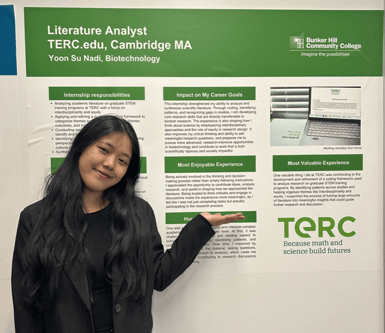
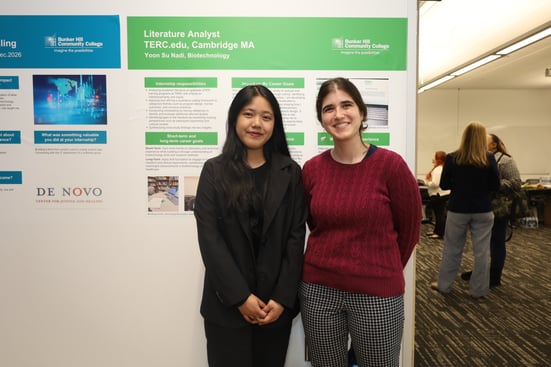
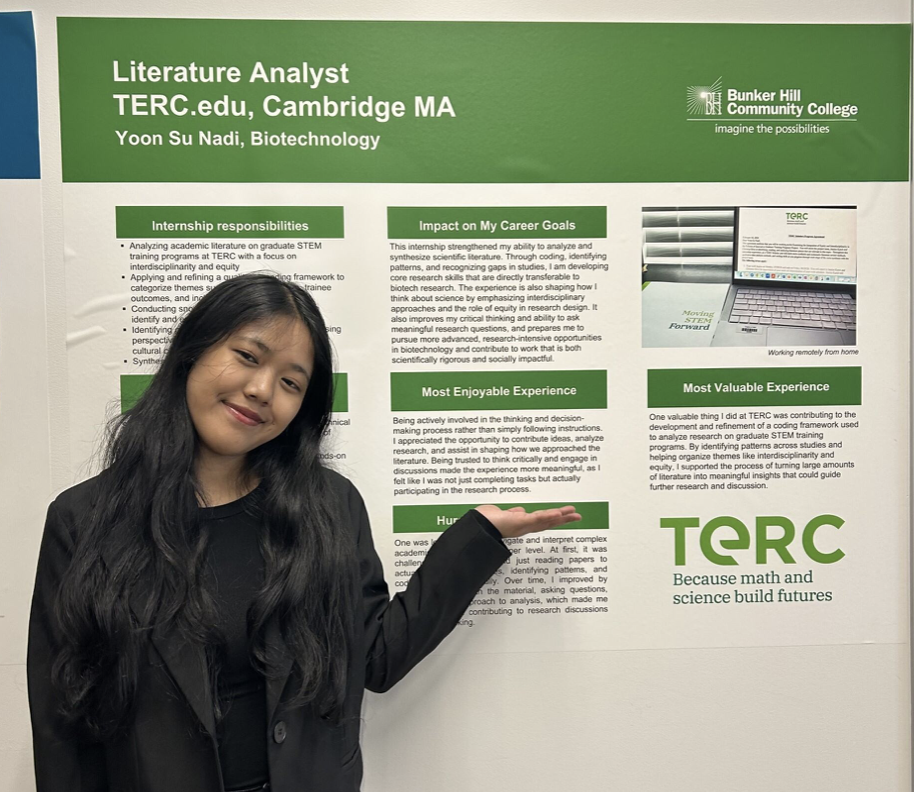
* The poster session photos are from Yoon's poster session for the Learn and Earn program at Bunker Hill Community College.


.jpeg)
-Bonda.jpg)